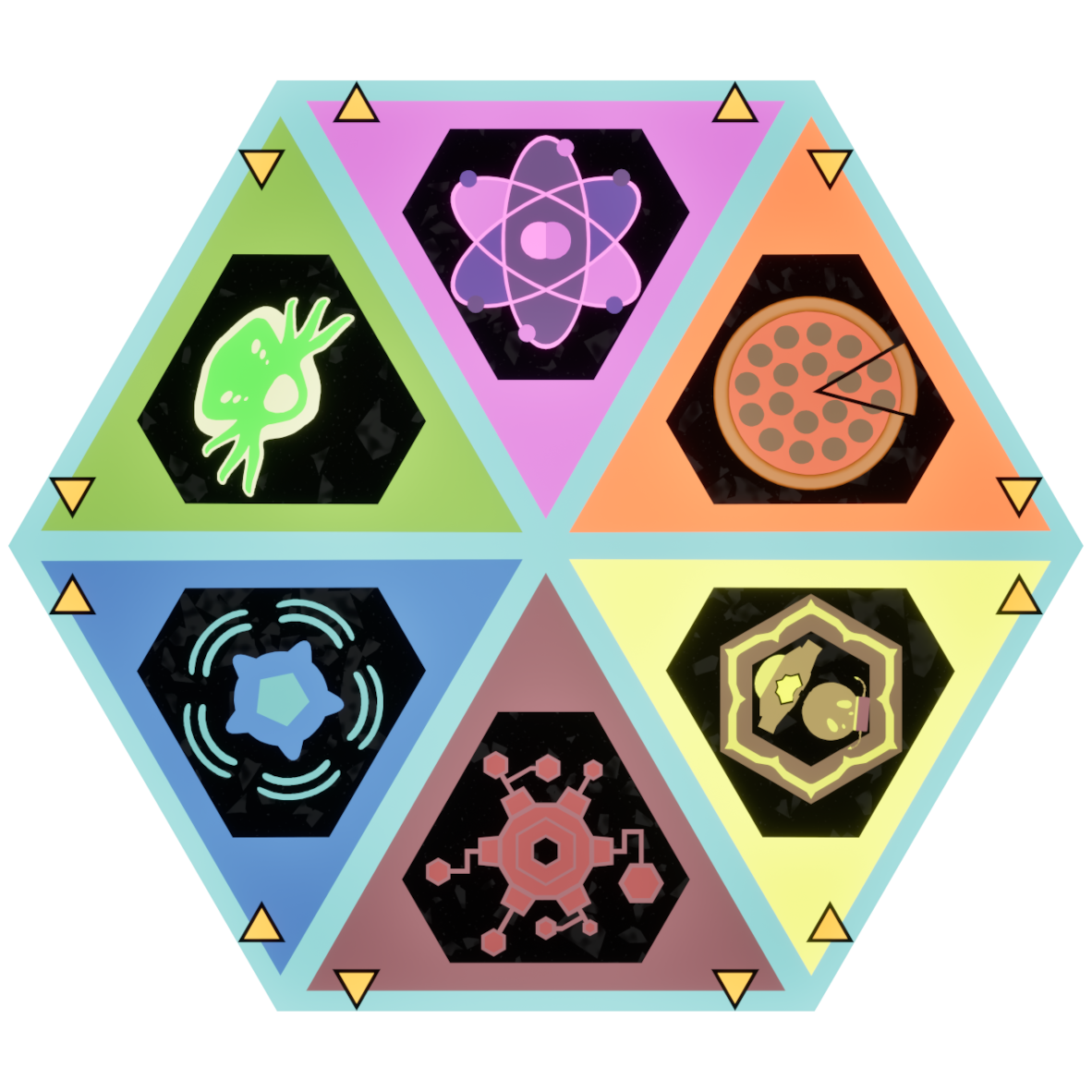
Six actions on a hexagon. You turn it, you lock it, and it tells you
what your turn is. We built it for a board game, years before either
of us had ever worked with an AI. It has turned out to be the best
piece of technology we own — for people, and for the machines that
now work beside them.
Research, Lodging, Staff, Renovation, Advertisement, Ghost — always
in that clockwise order, always in the same place. At the start of
your turn you rotate the hex and lock it. Point at one action and you
Focus: that action, twice. Point between two and you
Diversify: one of each.
That is the entire decision. Everything else on your turn — staffed
rooms, Faction tokens, the Random Action die — adds to what the hex
gave you. Try it: tap an action, or turn the hex a step at a time.
Focus
Research + Research
Position 1 of 12
What it means for game design
The rules live in the shape.
Most games explain their choices in a rulebook. The Action Hex makes
most of them impossible to get wrong, because the object only turns
the ways the game allows.
Twelve moves, never more.
Point the hex at one action and take it twice — Focus. Point it between two neighbours and take one of each — Diversify. Six of one, six of the other: twelve positions on the dial. Every turn of every game starts from a menu a person can hold in their head at once.
Neighbours are a trade-off.
You can only Diversify across an edge. Research sits next to Lodging and Ghost, and nowhere near Renovation. A player who wants two far-apart things has to choose, or plan a turn ahead — and that tension is the game, built into the shape rather than written into a rule.
Opposites are the balance.
Across the hex, three steps away, is the action you are worst at. Each Faction is strongest at one action and weakest at the one opposite it — so The Deep’s strength is exactly The Dread’s weakness. Balance is not tuned number by number. It falls out of the geometry.
One ring indexes everything.
Actions, Factions, rooms, amenities, beds, guests, Faction tokens — all sit on the same six positions in the same clockwise order. Learn the ring once and you can read every component in the box. That is the Rule of 6.
The same hex sits at the centre of the board game, the browser game,
Vacancy, and the small hex games on your phone. One piece of design,
carried unchanged from cardboard to code.
Why AI reads it too
A menu a machine can’t misread.
We did not design the hex for artificial intelligence. There was
none at our table when we built it. But the properties that make it
easy for a new player — few choices, fixed places, no illegal move to
stumble into — are exactly the properties an AI needs to act well and
fast in a world that keeps changing under it.
Legal by construction.
A non-adjacent pair is not refused by the engine — it cannot be expressed at all. There is no thirteenth position to reach for. When an AI takes a seat at our table, the whole of its choice on the hex is a list of twelve, and every item on the list is legal.
The same menu for everyone.
People and AI players get the same twelve positions, the same order, the same names. There is no second interface for the machine and no hidden one for the human. What one of them can do, the other can see.
Small, stable, addressable.
Six named places and one fixed order give every action an address that never moves. A person builds muscle memory against it; a machine can name any action in a word and be understood. Both are reading the same map.
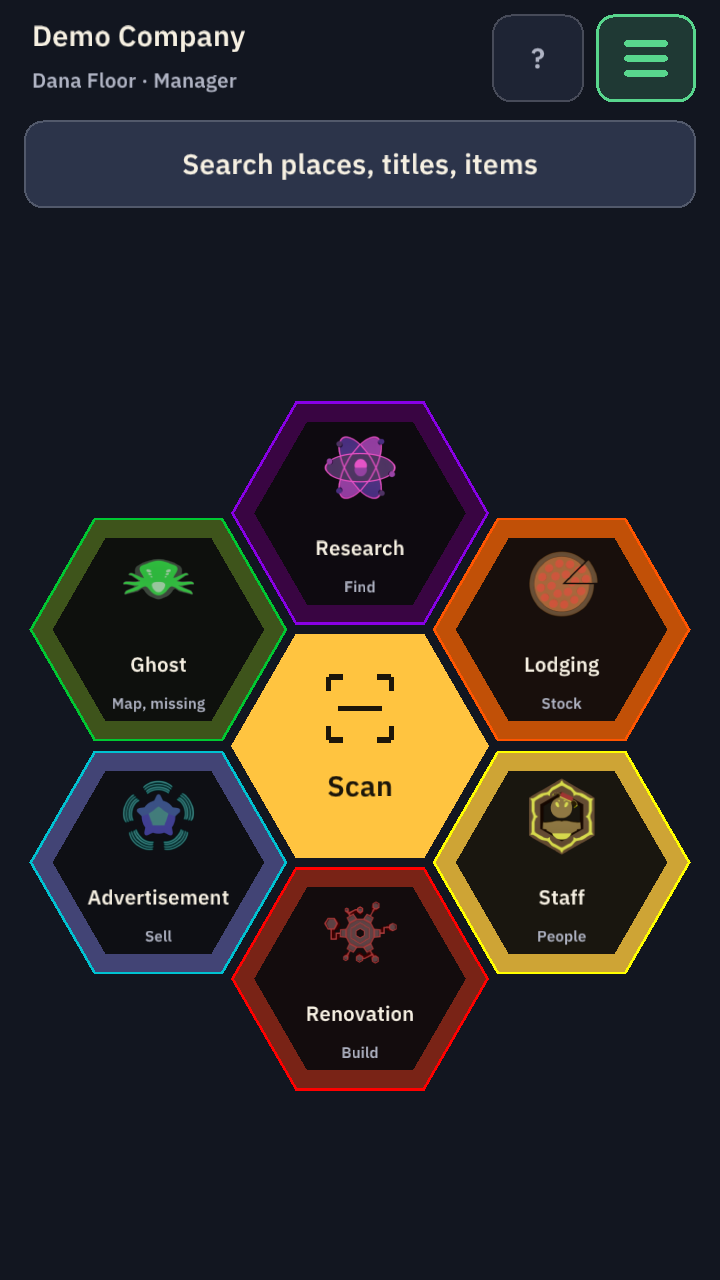
HexTracker’s Home screen, shown with its built-in demo company.
From the table to the warehouse floor
Now it runs a business.
HexTracker is an inventory system we are building
for a working business — every box, shelf, book and artwork, where it
is and how it got there, carried on a phone by the people on the
floor. Its Home screen is the Action Hex. Scan sits
in the middle, because it is the job done most. Around it, the six
actions of Haunted Space Hotel each hold a family of real jobs.
Research · FindSearch, look up, reports — and photos for the AI to read.
Lodging · StockEvery place, what is in it, moves, counts and value.
Staff · PeopleWho is on, their roles and their progress.
Renovation · BuildNew places, labels, printing, grading and corrections.
Advertisement · SellSales, orders, shipping and alerts.
Ghost · Map, missingThe 3D map, what is missing, conflicts, held changes.
Why it works when things move fast.
A business floor changes by the minute: stock arrives, moves, sells,
goes missing, turns up again. What must not change is where you go to
deal with it. Six places, always in the same order, always in the same
spot on the screen — so a new hire finds their way on day one, a
veteran does it without looking, and nobody hunts through menus while
the world moves under them.
It is just as legible to the AI working alongside them. The system
reads photographs of shelves and suggests what it sees; the suggestion
lands in Research, where a person accepts it, corrects
it or throws it out. The AI suggests. A person decides.
Nothing becomes a record until someone puts their name to it. The hex
gives both of them the same map, and keeps the human hand on it.
The part we didn’t plan
It clicks.
The Action Hex was on our table long before either of us worked with a
large language model. Scipraxianism — the philosophy Michael Clark and
Andrew Piper developed over many years, and the one the Factional
Omniarchy of Snohe adopts in the Haunted Space Hotel universe — came
before that. Its working layer is a set of Twelve Variables:
not commandments, but ways of looking at a situation before you act on
it.
Nobody designed the two to fit. Then we laid the Variables on the hex,
and they sat there in six sectors of two — on a dial that, as it
happens, has exactly twelve positions. A way of seeing and a way of
choosing, built separately, years apart, turned out to be the same
shape. It is printed in the rulebook now.
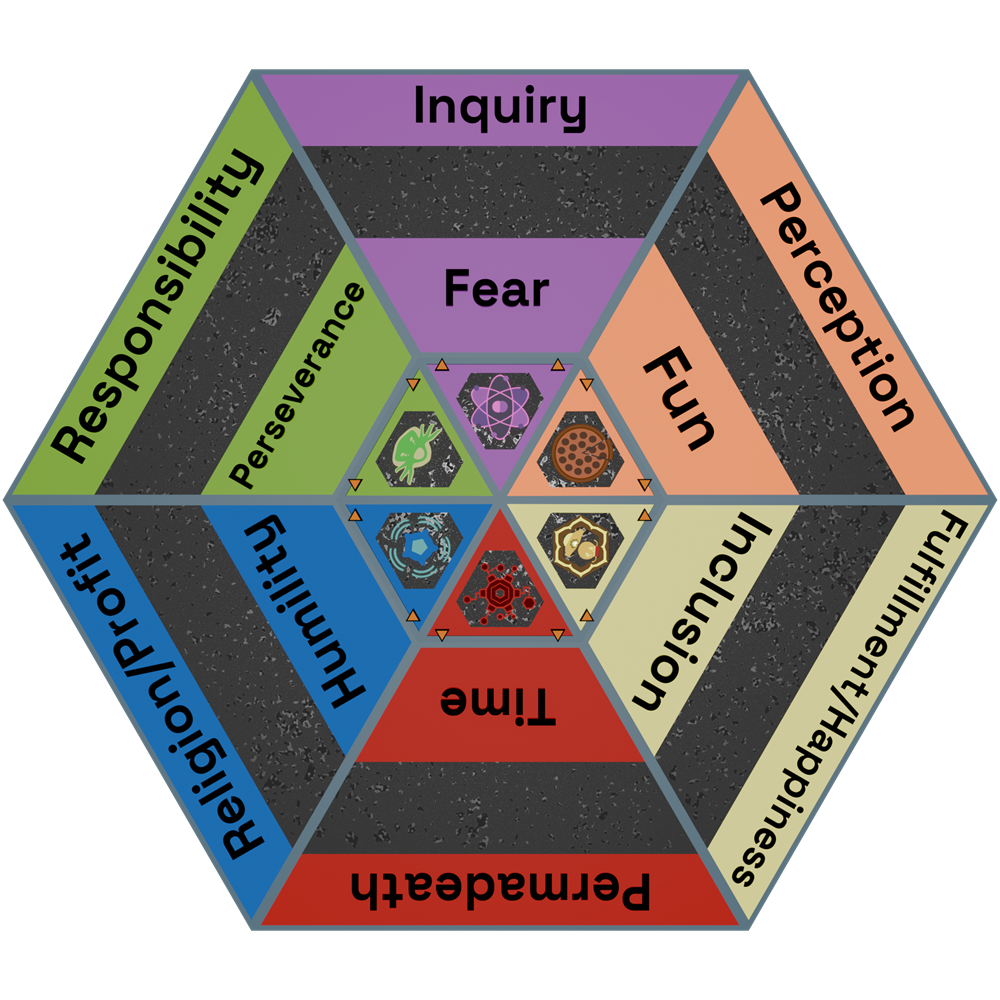
The Twelve Variables on the Action Hex, as printed in the Manager rulebook.
ResearchFear · Inquiry
LodgingFun · Perception
StaffInclusion · Fulfillment or Happiness
RenovationTime · Permadeath
AdvertisementHumility · Religion or Profit
GhostPerseverance · Responsibility
That is the Action Hex, and that is the Rule of 6. A handful of honest
choices, arranged so that neighbours are trade-offs and opposites are
balance, readable at a glance by a person and without ambiguity by a
machine. We built it to make a game. It keeps turning out to be for
more than that — for humans, and for the super-intelligences we now
build and work beside. We are very proud of it.